

Prepared By : Ronit Munde
In today’s digital-first world, organizations rely heavily on complex and distributed infrastructure spanning cloud, hybrid, and on-premise environments. This interconnected setup powers innovation, but it also introduces unprecedented challenges in keeping systems secure, reliable, and resilient.
While traditional monitoring tools focus on uptime and performance, modern enterprises are realizing that true infrastructure security starts with observability. After all, you can’t protect what you can’t see and visibility into every moving part of your IT ecosystem is now a security necessity, not just an operational luxury.
Why Infrastructure Security Matters More Than Ever
The modern enterprise infrastructure is vast and dynamic. From microservices and APIs to containers and virtual machines, every component can become a potential entry point for cyber threats.
Recent years have seen a surge in attacks targeting cloud misconfigurations, unpatched services, and weak monitoring practices.
The consequences are severe data breaches, system downtime, compliance failures, and reputational damage. Beyond technical implications, these incidents directly impact customer trust and business continuity.
Infrastructure security goes beyond preventing unauthorized access; it ensures:
- Uptime and Reliability: Protecting against failures caused by malicious or unexpected activity.
- Data Protection: Safeguarding sensitive information flowing across systems.
- Compliance Assurance: Maintaining adherence to frameworks like ISO, SOC2, and GDPR.
- Business Continuity: Ensuring fast recovery and minimal disruption when incidents occur.
As organizations scale their operations, traditional monitoring struggles to keep pace. What’s needed is a more intelligent, data-driven approach that’s where observability steps in.
From Monitoring to Observability: A Security Enabler
Monitoring tells you when something breaks; observability helps you understand why it broke and, increasingly, whether it’s a sign of a deeper issue like a security breach.
Observability unifies metrics, logs, traces, and events to give teams full-context visibility across infrastructure layers. This holistic view allows security and operations teams to detect irregularities early and act before damage occurs.
Here’s how observability empowers infrastructure security:
- Anomaly Detection: Identifies unusual patterns in usage or behavior (like sudden traffic spikes or abnormal CPU activity).
- Root Cause Analysis: Correlates data across systems to pinpoint the source of threats.
- Behavioral Insights: Tracks how systems behave under normal conditions to flag deviations.
- Faster Incident Response: Cuts down Mean Time to Detect (MTTD) and Mean Time to Respond (MTTR).
Consider this: a sudden spike in resource usage might not just be a performance issue. It could signal a crypto-mining attack or unauthorized process execution. Observability provides the data and context to tell the difference enabling teams to act faster and smarter.
How Algomox Enhances Infrastructure Security
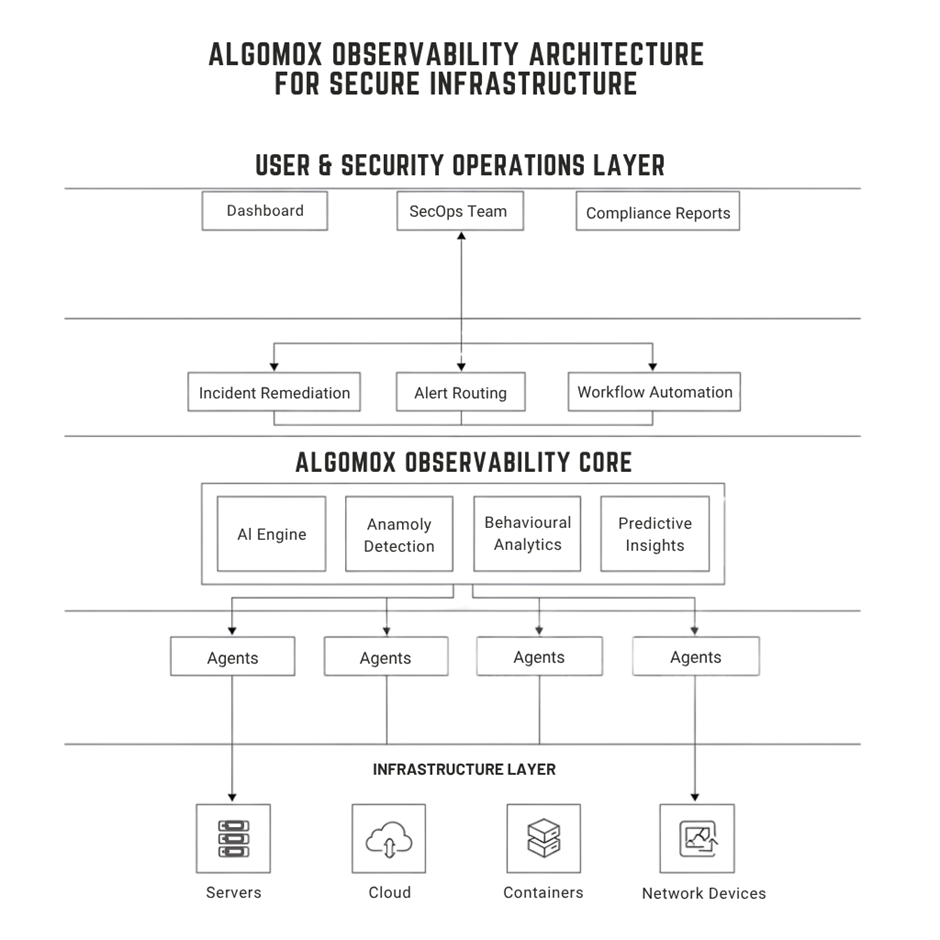
Algomox Observability redefines how organizations monitor and secure their IT environments by infusing artificial intelligence and automation into the heart of observability. Rather than waiting for alerts or logs to point out problems, Algomox anticipates them empowering proactive security and operational resilience.
Here’s how Algomox makes a difference:
1. AI-Driven Anomaly Detection
Algomox leverages advanced machine learning models to establish dynamic baselines for infrastructure behavior. Any deviation whether in network traffic, application latency, or resource consumption is instantly flagged for investigation. This helps detect potential threats long before they escalate.
2. Predictive Insights and Automated Remediation
Instead of reacting to alerts, Algomox predicts possible incidents. Its automation layer enables self-healing responses, such as isolating a compromised node, restarting a failing service, or alerting the right team instantly.
3. Unified Visibility Across the Stack
From application metrics to cloud infrastructure, Algomox offers a single pane of glass for complete operational visibility. This unified observability helps security teams correlate data from different layers, eliminating blind spots that attackers often exploit.
4. Behavioral Analytics for Threat Detection
By continuously learning normal usage patterns, Algomox identifies subtle deviations that may indicate insider threats, data exfiltration, or suspicious API activity giving organizations a powerful, intelligence-driven defense mechanism.
The Real-World Impact
The combination of observability and AI-powered automation has measurable benefits for security operations:
- Reduced MTTD and MTTR: Faster detection and resolution of potential security risks.
- Proactive Defense: Identifies threats before they can disrupt business operations.
- Compliance and Audit Readiness: Continuous visibility simplifies reporting and adherence to security standards.
- Operational Efficiency: Less manual triage and fewer false positives mean teams can focus on what truly matters.
Organizations leveraging Algomox Observability transform from reactive defenders to proactive guardians of their infrastructure.
Conclusion: Observability Is the Foundation of Infrastructure Trust
In a world where cyber threats evolve daily and infrastructures grow more complex, visibility is power. Observability is no longer just about ensuring performance it’s about ensuring security, stability, and trust.
Algomox Observability bridges the gap between IT operations and cybersecurity. By combining AI-driven insights, automation, and holistic visibility, it empowers organizations to stay ahead of risks and ensure their infrastructure is both high-performing and secure.
Infrastructure security begins with understanding your environment and Algomox helps you see, predict, and protect it better than ever before.